
In this article:
Stop Publishing Random SaaS Content: How to Build a Pillar Cluster Strategy That Actually Drives MRR
Most SaaS company blogs are graveyards of random, disconnected “how-to” articles. You write a post, publish it, pray to the Google gods, and watch it flatline at position 47 on the SERPs. Sound familiar?
Here is the hard truth: publishing scattered blog posts based on whatever keyword has a decent search volume doesn’t work anymore. Google’s algorithms have evolved. Today, search engines reward deep expertise. If you want to stop playing the keyword-guessing game and start dominating your niche, you need to fundamentally restructure your content architecture.
You need to execute a pillar cluster strategy saas leaders use to turn their blogs into revenue engines.
🧠 What Exactly is a Pillar-Cluster Strategy?
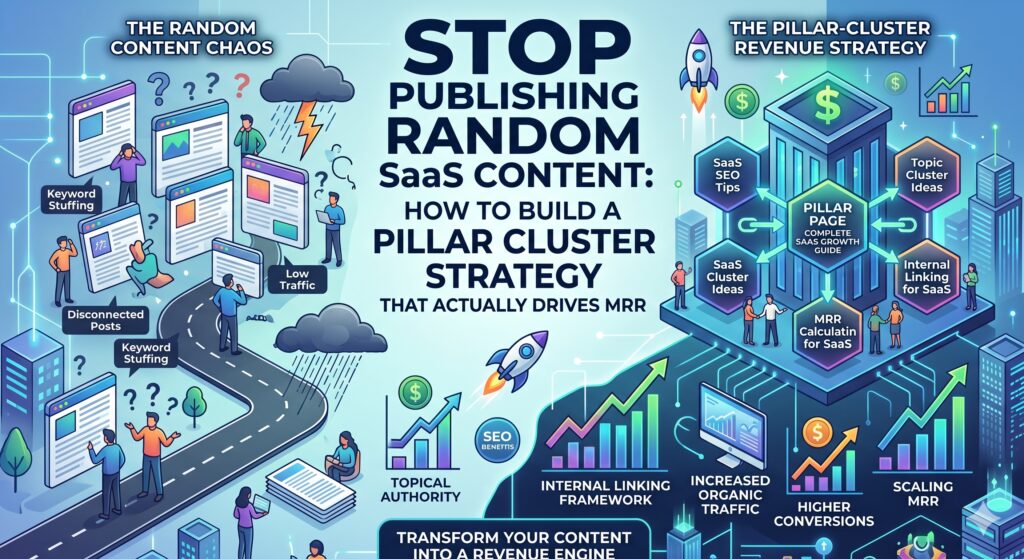
Think of your content like a wheel. The Pillar Page is the hub—a comprehensive, high-level guide covering a massive topic (e.g., “The Ultimate Guide to B2B Churn”). The Cluster Pages are the spokes—deep-dive articles targeting specific long-tail questions (e.g., “How to calculate churn rate”, “Win-back email templates”). The internal links connecting them all? That’s the rim holding the wheel together.
Why SaaS Needs “Topical Authority” Now More Than Ever
Let’s talk about topical authority. This is the secret currency of modern SEO.
Google doesn’t rank Monday.com for “project management software” just because they wrote one really good article about it. They rank them because Monday.com has published hundreds of interconnected articles about every conceivable micro-topic within project management. They didn’t just target a keyword; they built a digital encyclopedia.
Search engines assess how well your domain covers a subject in its entirety. When you use a structured saas SEO topical authority pillar cluster model, you are sending a massive, flashing neon sign to Google saying: “We are the undisputed experts on this specific problem.”
⚠️ The Cannibalization Trap
Without a cluster strategy, SaaS teams inevitably write five different articles over two years that all accidentally target the same broad keyword. The result? Keyword cannibalization. Your own pages fight each other in the search results, ensuring none of them ever crack the top 3. Clusters solve this instantly by giving every page a strictly defined purpose.
How to Build Your SaaS Pillar-Cluster Architecture (Step-by-Step)
Ready to build? Here is the exact blueprint to deploy a high-traffic pillar cluster strategy saas marketing teams can use to steal market share from heavier-hitting competitors.
Step 1: Identify Your Core “Pain Point” Pillars
Don’t pick pillars based on what your software does (e.g., “AI Data Analytics”). Pick pillars based on the problems your Ideal Customer Profile (ICP) is trying to solve before they even know your product exists.
- Good Pillar: “The Complete Guide to Reducing Customer Acquisition Cost”
- Bad Pillar: “Why Our Software is Great at Analytics”
You should only have 3 to 5 core pillars. If you have 20, you aren’t building pillars; you’re just writing regular blog posts. A true pillar is broad enough to support 15+ sub-articles beneath it.
Step 2: Map the Spoke Keywords (Cluster Content)
Once you have your pillar, it’s time to build the cluster. These are your hyper-specific, intent-driven, long-tail articles. This is where you answer the exact questions your sales team hears on demo calls.
If your Pillar is “Employee Onboarding,” your clusters might look like this:
- How to onboard remote software engineers (30-60-90 day plan)
- The true cost of bad employee onboarding
- Best employee onboarding software alternatives for 2026
- Free employee onboarding checklist template (PDF)
Step 3: The Internal Linking Protocol (The Magic Ingredient)
This is where 90% of SaaS content marketers fail. You can write the best content in the world, but if it isn’t linked correctly, your topical authority will flatline.
The rules of a saas SEO topical authority pillar cluster are non-negotiable:
- The Pillar Page must link out to every single cluster page.
- Every Cluster Page must link back to the main Pillar Page (preferably high up in the introduction).
- Cluster pages should link to each other when contextually relevant.
⚡ Pro Strategy
Write the Clusters FIRST
It sounds counterintuitive, but don’t start by writing the massive 5,000-word Pillar Page. Write 5 or 6 cluster articles first. Publish them. Then, write the Pillar Page. It is infinitely easier to write a hub page when you already know exactly what detailed content you are summarizing and linking out to.
Measuring Success: How to Know if It’s Working
Topical authority doesn’t happen overnight. It takes Google time to crawl, index, and understand the semantic relationships between your pages. But when it hits, the hockey-stick growth is undeniable.
Stop tracking individual keyword rankings on a daily basis. Instead, track the success of the cluster as a whole. You are looking for:
- Share of Voice: Are you appearing in the SERPs for a broader variety of terms within that specific topic?
- Reduced Click Depth: Are users exploring more pages per session because your internal links are guiding them perfectly down the funnel?
- Pillar Page Traffic: The ultimate sign of success is when your broad, high-competition Pillar Page starts ranking for massive head terms because the cluster pages have fed it so much authority.
The Bottom Line
A scattered content strategy yields scattered revenue. By organizing your SaaS blog into a deliberate, interconnected web of information, you stop competing on a page-by-page basis and start competing on a domain level.
Build your pillars. Write exhaustive clusters. Link them relentlessly. Establish your topical authority, and watch your organic pipeline fill with buyers who already trust you before they ever book a demo.
Ready to Dominate Your SaaS Niche?
Stop struggling with scattered content. Let us help you execute a proven SEO and topical authority framework that scales your MRR.