SaaS Pillar Cluster Strategy: The Framework for Content Topical Authority

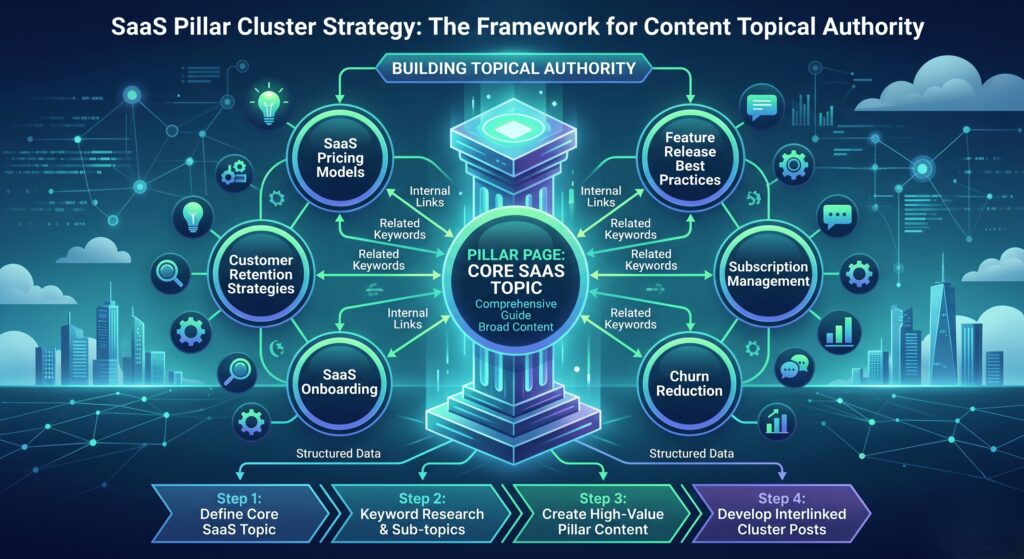
A conceptual diagram showing a SaaS content pillar page in the center connected to multiple cluster blog post topics to build topical authority.

If you are running marketing for a SaaS platform, you already know that the old playbook of targeting disconnected, long-tail keywords is completely dead. Search engines no longer rank isolated pages based on keyword density. Today, search algorithms reward deep, interconnected topical expertise.

For modern software companies, scaling organic growth requires a shifts in architecture. You must transition from writing standalone blog posts to building a cohesive, structured matrix. In technical SEO, this framework is known as a pillar cluster strategy. When executed correctly, it is the most predictable way for a saas company to establish undeniable content topical authority and dominate competitive search engine result pages (SERPs).

This comprehensive, block-style guide breaks down the exact, blueprint-style methodology for planning, mapping, and deploying a high-converting pillar-cluster framework tailored specifically for the software ecosystem.

Why the Pillar-Cluster Model Is Mandatory for SaaS

The standard SaaS buying journey is complex, non-linear, and informational. A prospect rarely searches for a core product keyword (e.g., “project management software”) and buys on the first visit. Instead, they search for symptoms of their problems, industry best practices, and integration workflows over several months.

The pillar-cluster model mirrors this journey perfectly by grouping content into logical, hierarchical hubs:

The Pillar Page

A comprehensive, high-level overview page covering a broad core topic. It targets high-volume, high-competition root keywords and links out to supporting assets.

The Cluster Content

Highly specific, tightly focused articles targeting long-tail queries. These pages dive deep into subtopics and always link back to the primary parent pillar page.

By organizing your site structure this way, you signal to search engine crawlers that your platform doesn’t just mention a topic—it owns the entire subject ecosystem. This structural signal is what builds scalable search engine trust.

Step 1: Identifying Your Core SaaS Pillars

A fatal mistake many B2B content teams make is building pillars around keywords instead of product monetization lanes. Your pillars must sit at the intersection of user pain points, search volume, and product features.

The Rule of Three to Five

For an early to mid-stage software product, do not attempt to build dozens of hubs simultaneously. Focus on three to five core thematic pillars that map directly to your primary product modules or customer use cases.

To identify these, ask your sales and product teams: What are the macro-problems our software solves? If you sell an automated accounting platform, your pillars shouldn’t just be “accounting tips.” Instead, your strategic pillars should look closer to this alignment profile:

SaaS Vertical Core Product Module Target Pillar Topic
FinTech / Accounting Automated Invoicing Accounts Receivable Optimization
HR Tech / ATS Remote Onboarding The Enterprise Employee Onboarding Guide
MarTech / CRM Lead Scoring Pipeline B2B Sales Pipeline Management

Step 2: Conducting Keyword Research for Topical Authority

Once your macro pillars are established, you need to map out the supporting cluster articles. The goal here isn’t simply finding high-volume keywords; it is mapping out every single subtopic required to achieve true semantic completion.

Brainstorming Content Nodes

To find cluster ideas that search engine algorithms recognize as relevant, combine standard keyword tools with qualitative user discovery networks. Analyze communities like Quora, Reddit, and specialized Slack groups. Dig into the “People Also Ask” (PAA) drop-downs on Google search results pages.

💡 Pro-Tip for Semantic Scoping:

If your competitor’s pillar page ranks #1, extract their entire URL profile into an organic research tool. Filter for sub-queries they rank for between positions 2 and 15. Every single one of those secondary terms represents a potential standalone cluster article for your site.

For every single pillar page, aim to plan out at least 15 to 30 distinct cluster articles. This comprehensive density ensures you create an inescapable gravity well of semantic coverage that algorithms cannot ignore.

Step 3: Engineering the Internal Link Architecture

You can write the most brilliant articles in the world, but if your internal link distribution is broken, you will never establish genuine domain equity. The magic of a successful pillar cluster strategy lies completely within its programmatic link routing structure.

The Core Rules of Cluster Linking:

  1. The Spoke-to-Hub Link: Every single supporting cluster article *must* link back to the main parent pillar page using exact or close-variant target anchor text.
  2. The Hub-to-Spoke Link: The main pillar page must feature a natural contextual link or an organized directory listing that points out to every individual cluster page.
  3. Horizontal Spoke-to-Spoke Link: Cluster articles can link to one another, but *only* if they share the exact same parent pillar page and add direct contextual value for the reader.

Never cross-link sibling cluster pages from entirely separate pillars unless it is contextually necessary. Keep your link silos clean to ensure search engines can instantly parse the thematic taxonomy of your digital footprint.

Step 4: Writing Content that AI Cannot Replicate

With search engines flooded by generic, generative-AI content, software brands must prioritize editorial depth over content volume. Algorithms increasingly favor firsthand expertise, unique data insights, and human perspectives.

Injecting Proprietary “SaaS Product Proof”

To insulate your articles from search updates and copycats, build an uncopyable content framework into your standard operational drafts:

Step 5: Optimizing the On-Page UX and Conversion Pathways

A content hub shouldn’t just be an information library—it should function as a highly optimized customer acquisition funnel. Because your cluster articles target users at different stages of awareness, your on-page conversion goals must shift to match user intent.

Mapping Intent to Layout CTAs

For Top-of-Funnel (ToFu) informational pages, pushing a “Book a Demo” CTA right away usually results in high bounce rates. Instead, direct that traffic toward a friction-free email opt-in, such as an interactive template, calculator, or actionable checklist.

Save your high-intent product modules, case studies, and sandbox sandbox trial CTAs for Bottom-of-Funnel (BoFu) long-tail cluster articles (e.g., product alternatives or integration comparison landing pages).

Conclusion: Compounding Search Equity Over Time

Deploying a successful pillar cluster strategy requires patience, upfront resources, and disciplined execution. However, unlike paid acquisition campaigns that stop delivering results the moment you turn off the spend, a properly built organic cluster network creates compounding authority equity.

Ready to Dominate B2B Search Rankings?

Building data-driven semantic structures, mapping complex user pathways, and driving organic pipeline requires deep technical SEO expertise.

Partner with the Growth Experts at Rank and Promote