
In this article:
You just spent thousands of dollars on Google Ads and LinkedIn campaigns. Your ad copy is dialed in. The creative is stunning. A high-intent prospect clicks your ad, and then… they stare at a blank white screen for 4 seconds before hitting the “back” button. Congratulations, you just paid $15 for a bounce.
Here is the reality of modern performance marketing: your brilliant copywriting and irresistible offers mean absolutely nothing if your page doesn’t load instantly. We live in the TikTok era of attention spans. If your page stutters, you lose the lead.
Mastering landing page speed optimization isn’t just an IT chore for your developers—it is the single highest-leverage growth lever you have to dramatically improve your bottom line.
🧠 The “3-Second” Death Zone
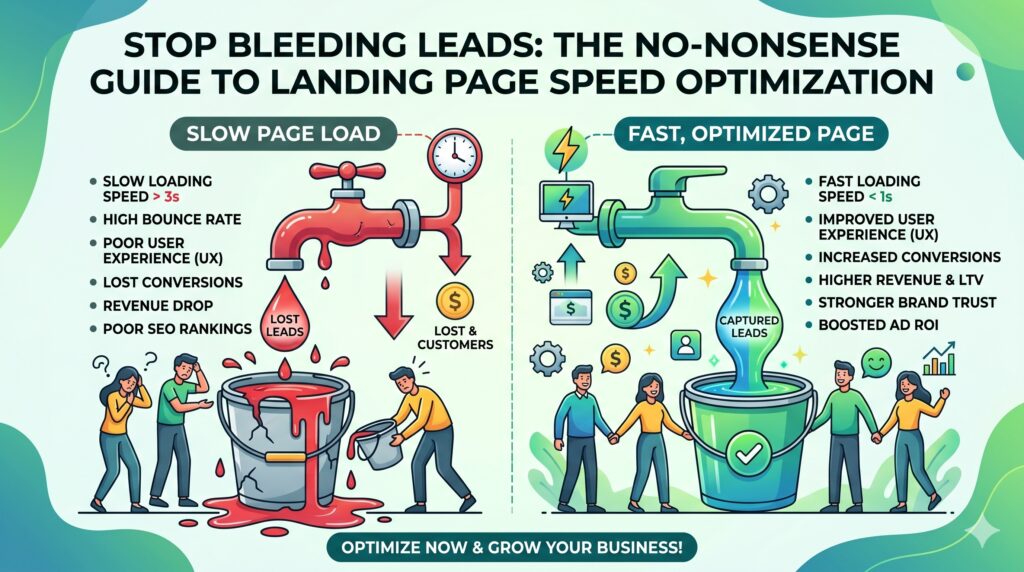
Google’s own benchmark data is terrifyingly clear: if your page load time goes from 1 second to 3 seconds, the probability of a bounce increases by 32%. Pushing it to 5 seconds? That bounce probability skyrockets to 90%. Every millisecond your page thinks about loading is a millisecond your prospect spends reconsidering their click.
The Direct Link Between Speed and Conversion Rates
Let’s talk about conversion rates. Marketers love to A/B test button colors, headline fonts, and hero images. But they completely ignore the fundamental delivery mechanism of those elements.
Amazon calculated that a page load slowdown of just one second could cost them $1.6 billion in sales each year. While your SaaS or lead-gen agency might not be pulling Amazon numbers, the proportional impact is exactly the same. When you execute proper landing page speed optimization, your Cost Per Acquisition (CPA) drops organically because more of your paid traffic actually gets to see your pitch.
⚠️ The Page Builder Trap
Drag-and-drop page builders are amazing for rapid prototyping, but they are notorious for injecting massive amounts of bloated, unnecessary code (DOM elements) into your pages. If your landing page relies on 14 different plugins and a heavy visual builder theme, your conversion rates are going to suffer due to the underlying code bloat.
How to Fix Your Landing Page Speed (Step-by-Step)
You don’t need a PhD in computer science to fix this. Here are the most critical steps to slash your load times and capture more leads.
Step 1: Destroy Massive Image Files
This is the #1 offender. Uploading a 4MB PNG image straight from Unsplash to your hero section is marketing sabotage. You need to serve modern, lightweight image formats.
- The Fix: Convert all JPEG and PNG files to WebP format. It provides the same visual quality at a fraction of the file size.
- The Rule: No single image on your landing page should be over 200KB. Period.
Step 2: Tame Your Third-Party Scripts
We all love data. But installing the Facebook Pixel, Google Analytics, Hotjar, a chatbot, LinkedIn Insights, and a pop-up tool all on the same page will paralyze your rendering speed.
- Audit your Google Tag Manager container and pause tags you aren’t actively using.
- Delay the loading of chatbots until the user scrolls or has been on the page for 5 seconds.
- Host critical scripts locally when possible instead of relying on external DNS lookups.
Step 3: Leverage a Content Delivery Network (CDN)
If your server is in New York, a user clicking your ad in London has to wait for data to travel across the Atlantic ocean. A CDN (like Cloudflare) solves this by caching your landing page on localized servers all over the globe, ensuring the data only has to travel a few miles to reach the user’s screen.
⚡ Pro Strategy
Implement “Lazy Loading”
Don’t force the browser to load the footer images, testimonial videos, and pricing tables before the user even sees the hero section! Implement “lazy loading” so that images and videos below the fold are only downloaded the exact moment the user scrolls down to look at them. This tricks the browser into loading the visible part of the page instantly.
The Bottom Line
Stop pouring marketing budget into a leaky bucket. A slow landing page actively destroys trust, spikes your bounce rate, and wrecks your ad quality scores. By prioritizing landing page speed optimization, you instantly create a smoother user experience that directly translates to higher conversion rates and cheaper leads.
Audit your page today. Compress those images, defer those scripts, and watch your cost-per-lead drop.
Is Your Funnel Leaking Leads?
Don’t let a sluggish website destroy your ad ROI. We build lightning-fast, high-converting digital assets that turn clicks into paying customers.